You probably never guess that Aya Hirano is 20-years-old, unless Itold you that she was born October 8, 1987. This young beauty fromAichi Prefecture, Japan, is a J-pop singer who has had roles in severalanime, visual novels, and TV commercials in Japan.
She still on the rise as the lead role in Japan TV show, Lucky Star, and the much-anticipated season two of Haruhi. Aya Hirano Pics and Photos
God of War 3 is more than an action game: it’s the conclusion to a commercially successful and critically acclaimed series that acts as the ‘face’ of Sony’s entire gaming brand; what Master Chief is to Microsoft and Mario is to Nintendo, Kratos is to Sony. As such, God of War III was burdened with a Herculean set of tasks. But while it lives up to the high bar set by the previous installments, it can’t quite bear the weight of bringing the epic story of Kratos to a meaningful end. It’s still a finely crafted action experience that fully showcases the PS3's immense capabilities but it isn't the satisfying conclusion that fans both want and need.
GamePro Score
User Score
4.5 average rating from 51 votes
Talk about high expectations: as the final chapter in what is arguably the most successful action game franchise ever created, God of War III has a lot of things it needs to accomplish. One, it has to be a huge commercial success; two, it has to showcase the full capabilities of the PS3 hardware and raise the bar in terms of visual quality and gameplay refinement; and finally, it has to cap off the series' narrative arc in a way that not only meets fan expectations but brings all of the threads together into a cohesive and satisfying end. God of War III gets the first two things right (or will, in the case of the sales numbers-even though the PS3 has a comparatively smaller installed base than the PS2 or original PlayStation, you can safely expect God of War III will become a best seller) but it doesn't do the most important thing: bring the story of Kratos to a meaningful end. Because God of War III is the culmination of one of the most iconic action game franchises, there's a lot hanging in the balance. Kratos isn't some meathead mindlessly pounding his way to the end credits: there's a lot of history and subtext to his one-man war against Mount Olympus, and there was a tremendous amount of pressure to bring everything to a showstopping conclusion.
The opening moments of God of War III are amazing, topping even the memorable Colosuss of Rhodes fight from God of War II.
But God of War III doesn't do that, delivering instead a weak and uneven narrative that's full of plot holes; it's a small vulnerability in an otherwise stellar game, but that's all you need to bring down a hero sometimes -- just ask Achilles. I've invested a lot of time and energy into Kratos' journey, and I both wanted and needed God of War III to make sense of the whole thing. There is an admirable attempt made to tie up all the loose ends and give some meaning to Kratos' struggle, but the narrative lacks the sense of momentum and drive that made the series so special. The quality of the actual gaming experience, and what the game means to the PS3, is undeniable, but from a storytelling perspective, I consider it a bit of a failure.
The last image most gamers have of Kratos is him scaling Mount Olympus on the back of the Titan Gaia towards a climatic confrontation with Zeus. God of War III wisely picks up right at that point, and while the initial fight up to the peak is awe-inspiring -- the introductory sequence bests the previous high-water mark for the series, the Colossus of Rhodes fight from God of War II -- things soon go awry. After letting you get this close to Zeus, the dev team pushes the reset button on Kratos and sends him back to the beginning where he once again loses all of his powers and gear; as a narrative device, it's a little cheap but it's forgivable considering the circumstances. If they'd let you fight Zeus right there and then, the game would be over in about two hours. But what's really problematic about the whole thing is how it's handled: the way Kratos is kicked off the mountain is not only a little ridiculous but incredibly anti-climatic as well. Without ruining anything, Zeus essentially goes "Shoo," and sends Kratos back to the starting line.
God of War III fully leverages the power of the PS3, delivering visuals that are some of the best I've seen on any console.
The plot incongruities slowly start to pile up from there: for one, you're kicked out of the way in the middle of an epic battle between the gods of Olympus and the Titans but you sort of get lost in your own little adventure, and the war, which would seem like it should be a focal point, fades into the background. Also odd is the fact that the assembled gods of Olympus show up to test you along the way but Zeus remains curiously absent throughout. It's almost as though he's purposefully turning a blind eye to everything, which doesn't make a whole lot of sense considering his estranged son brings a war into what is essentially his living room.
There's a moment in the first God of War when Ares kills Kratos by throwing a piece of rock halfway across creation and it isn't a stretch to assume Zeus could do something similar because so much is made of the fact that he isn't just a god but the god; and yet, rather than just snap his fingers and turn Kratos into a pile of ash, he ignores him and only pops up after Kratos has accumulated the power to destroy him. It's weak characterization and it's especially disappointing when you compare him to Kratos, a character whose plight and motivation is never in question. We know what makes him tick but what about Zeus? He's a central character in the narrative arc and yet, he almost lives backstage, appearing only when it's convenient to the plot; he's literally a deus ex machina. There's an attempt made at the end that tries to explain his behavior but it's a convenient plot device -- it's the Greek myth equivalent of the "temporary insanity" defense -- that doesn't quite work. All of this may not seem like a big deal to some of you but these are the sorts of questions I, as a gamer who's fully invested himself into the franchise, want answered and addressed, and I have a right to feel disappointed if they're not.
The war between the Titans and the gods of Olympus curiously fades into the background during Kratos' adventure.
This isn't to say that the story is completely devoid of poignancy and meaning. There are actually a few moments of note, including one involving Kevin Sorbo of all people -- he appropriately voices Hercules, who is also a son of Zeus, and though he isn't around for long, I appreciated the angst and pathos that he brought to his "scene"; he shows a genuine bit of emotion that adds a subtle layer of complexity to Kratos' relationship with Zeus. Kratos' interaction with Zeus' wife Hera is also interesting because of the way he ultimately deals with her; it's jarringly abrupt, to say the least, but it's perfectly in keeping with who Kratos has become at that point in the proceedings. You really start to see just how firmly in control the nihilistic side of his personality is: it's made abundantly clear at times that his mad quest for vengeance has ramifications far greater than his spiteful relationship with his father but Kratos makes it just as clear that he doesn't care: he's got something he needs to do and nothing, not even the destruction of the entire world, will delay him. As he slowly works his way through Mount Olympus' pantheon, you start to see visible signs of the effect that Kratos is having on the world, and the fact that he won't allow that to affect him is a powerful testament to the strenght of his will; so much could have been done with this but it's ultimately wasted on a thin storyline that meanders its way to an anti-climatic finish.
That God of War III fumbles the opportunity to leave a deep and lasting impression is especially unfortunate because it's been improved in just about every other way. Taken just as an action game, God of War III is terrific, rivaling the best of what's available not only on the PS3 but all platforms. It looks and feels like a generational step-up from the last title, with visuals that top games like Uncharted 2 and Killzone 2. There is a much needed refinement inherent in the gameplay as well: they've eliminated most of the clutter that plagued the past two titles and the teeth-gratingly difficult timing and block moving puzzles are a thing of the past.
Undead Spartans rise up against you with their trademark shield formation; it'll take more strength than usual to break through the ranks.
New weapons and abilities like the Army of Sparta, a 300 inspired ability which summons shield-bearing Spartans around Kratos along with a hailstorm of arrows onto the battlefield, and the Cestus -- a pair of lion-faced gauntlets that pack an Incredible Hulk-like wallop -- are welcome additions to the arsenal, even if the sheer number of tools at your disposal makes inventory management a clumsy chore. Certain moments also standout, like the clever use of the Icarus Wings as a mode of long-range travel, and the only thing missing from some of the memorable boss encounters is a booming voice shouting "Finish him!" as you deliver the gruesome final blow. The exquisitely rendered environments flow nicely into one another and though there is some backtracking involved, you never stay in one area long enough to grow tired of it; you'll travel from the heights of Mount Olympus all the way to the depths of Hades and back, and even if it doesn't always make sense from a narrative perspective, the actual journey itself is epic and grand.
It shouldn't come as a surprise that God of War III is a great action experience: although each game in the series was helmed by a different creative director -- Stig Asmussen, who worked on God of War III, took over for Cory Barlog, who, in turn, took over for David Jaffe -- they promoted from within the development team, meaning there is a sense of consistency throughout the entire franchise. The formula never changed: it was just refined and tweaked to fit the unique visions of the individual director. But the ever changing leadership hurt the games when it came to continuity, and God of War III's botched attempt to weave all the individual threads into a coherent ending leads me to believe the trilogy was conceived in parts rather than as a whole. Director Stig Asmussen had to incorporate the bits and pieces that Barlog and Jaffe left behind, and that makes God of War III feel like a Frankenstein construct of parts that don't seamlessly fit together. Because of this, there is a lot of plot filler of the "Hey, remember when you did this? Well, this is what happened as a result," variety.
Kratos is the star of the show but he is just a tiny speck compared to some of the other characters in the game.
My problem with God of War III's narrative basically boils down to this: Whenever I reach the end of a story that I've truly invested myself in, I always walk away feeling as though I've said farewell to a good friend with whom I went on a long and meaningful journey. It's a bittersweet moment, and I'm always left feeling equally thankful and sad that I've reached the end of the road. I didn't fully feel that with God of War III, and while this doesn't completely ruin the fun, it definitely affects my overall enjoyment of it. It still earns high marks because it's a tremendously well crafted action experience and I recognize some fans simply won't care that the story is weak -- they'll be happy just to take part in the spectacle (and what a spectacle it is). I also can't discount what an important piece of the puzzle this is for Sony; God of War III, along with recent releases like Heavy Rain and the impending Final Fantasy XIII, should give the company a strong boost in the traditional post-holiday lull. But as a fan who actually cares about Kratos and his plight, I found it to be a bit of a letdown. Even though I thoroughly enjoyed the journey, I can't help but feel disappointed by the way Kratos chose to say goodbye at the end of it PROS: A great action experience, with plenty of thrills and memorable moments; improves upon the franchise formula in almost every tangible way.
CONS: It doesn't bring the story to a satisfying conclusion and the attempts to make sense of Kratos' journey ultimately fall flat.
Infolinks is an in text advertising program and much like AdSense, it can be used by both publishers and advertisers. It's a really easy program to join and it can be a great way to monetize a new blog, or further monetize a blog that's already monetized.
Joining Infolinks:
I first joined Infolinks after being contacted by an Infolinks Representative asking me if I'd like to join their site. I had been looking for a good intext service like Infolinks for some time, so I figured that I would give them a try. [After trying Clicksor, I was definitely ready to try a program that sounded promising.]
Using Infolinks is easy!
I followed the instructions on Infolinks' website and went ahead and placed their code onto all of my blogs. At first, the Infolinks advertisements were obvious. Like most other intext advertising sites, Infolinks also had the double underlined links. [If you didn't know, double underlined links scream advertisements to all readers.] I decided to contact Infolinks support regarding the issue.
The next day, I received an email back showing me exactly how to remove the double underlined links and instead, display single underlined links.
[Update] The new Infolinks code simply allows you to choose whether you'd like single or double underlined links.
So implementation was really easy and really customizable with Infolinks [and it's even easier now!] They allow you to change the link color of your ad, the number of ads displayed on a page, and even your content's category with simple point and click implementation. (Seen in the picture above)
Infolinks Earnings:
Now, to the important stuff... The earnings. With Infolinks, you may at first be disappointed with the amount you get per click. This holds especially true if you're some sort of AdSense Guru. that gets $5.00 per click. However, when you begin to notice that you're getting more clicks because the Infolinks ads are better blended compared to other advertisements on your page, you'll stop complaining. My Infolinks earnings are very comparable to my AdSense earnings. I would say that for each $250-$300 I earn with AdSense, I earn between $125-150 with Infolinks. This is extremely good compared to other programs on the net. So far, I have racked up about $354 with Infolinks. [That's a nice little roll of dough.] And I expect that as my site grows, I will earn even more with this program.
Overall Impression
As you may not earn as much with Infolinks as you would with a program like AdSense, it is still a nice way to supplement your income. In fact, if you don't know much about AdSense or where to place your ads / or maybe AdSense just isn't working for you, Infolinks may be an even better option for you anyway.
[This holds especially true if you're running a website with web savvy readers. Web savvy readers rarely click AdSense advertisements simply because they know what ads look like. However, because Infolinks is so well-blended, people will click these ads and in turn, make you money.]
With all of that in mind, I would definitely give Infolinks a try. Their support is great, earnings are nice, and the overall, "What you get back in return feeling," is definitely a steal for a program that's free to join.
Update - 1st payment received on time!
[Update - 4/16/09] - I just received my first Infolinks payment through Paypal so for those who are doubters, doubt no longer. The payment came in a few days ago and I figured I would post an update and a screenshot letting you all know that I was in fact paid for my work.
Netherlands' Arjen Robben celebrates after scoring his team's third goal against Uruguay. (Fernando Vergara/AP)
CAPE TOWN, South Africa (AP)—Arjen Robben emerged from the bottom of an Oranje mosh pit, mud on his brow and a smile on his face.
For good measure, he threw kisses at his teammates and fans. His goal gave the Netherlands a 3-2 victory over Uruguay and a spot in the World Cup final.
Now that’s a Dutch treat!
The big prize—that elusive first title—is still one game away. But this was such a moment to savor that most of the squad made a curtain call nearly an hour after the biggest Netherlands victory in decades, leading about 1,000 orange-clad fans in cheers that figure to last until Sunday.
That’s when the Dutch play either Spain or Germany for the championship of the world.
“If you win the final, you make yourself immortal, at least in our country,” Robben said. “We will do everything we can to take the Cup back.”
Long wasteful with its soccer talent, the Netherlands sure has found the right touch in this tournament.
Stars Wesley Sneijder and Robben scored three minutes apart in the second half as the Netherlands advanced to its first title match since losing in 1978 to Argentina.
“We are so close,” Sneijder said. “There is nothing bigger than the World Cup.”
And nothing better than sharing it with their countrymen.
So out came Robben, Sneijder and their teammates long after the final whistle, to join the celebration in an empty stadium—empty except for that rollicking section of fans still singing Dutch songs, waving flags, and bowing in unison. The players joined in from the field, several on the shoulders of others, some taking photos. Back home in Amsterdam, the victory touched off mass celebrations, too.
Winners of all six games in South Africa, 10 in a row overall and in the midst of a 25-match unbeaten streak, the Dutch have the look of champions—with an Oranje hue, of course.
“This is unforgettable,” said Sneijder, now tied with Spain’s David Villa for top scorer at the tournament (five goals). “It was a tough fight and toward the end we complicated matters.
“Sunday we play in the World Cup final. I have to get used to that.”
Besides the loss to Argentina in ’78, the Netherlands fell in its only other appearance in the final, to West Germany in 1974.
Both of those title-game defeats came during the golden period of Dutch soccer, and in the opposition’s homeland. No such worries this time, and no country outside of Africa has had as much fan support as the Netherlands.
Inside Green Point Stadium it looked like a Florida orange grove. Outside, a Netherlands fan in a blue and white bodysuit stood on stilts and played a vuvuzela—badly. It was about the only thing that didn’t measure up for the Dutch.
And a tournament that looked like a South American fiesta early on will end in a European showdown for the second straight World Cup. Sneijder and Robben made sure of that.
Sneijder’s goal came somewhat unexpectedly because Uruguay had shut down the Dutch offense for much of the second half. His left-footed shot from just inside the penalty area barely ticked the leg of defender Maximiliano Pereira and, with Robin van Persie almost deflecting it again, the ball skidded past goalkeeper Fernando Muslera.
Then Robben sent a cross from Dirk Kuyt past a flat-footed Muslera with a brilliant header. His teammates piled on in an Oranje Crush celebration, and Robben came up from it muddied and merry—and with the knowledge that, ahead 3-1, the Netherlands was likely headed to the championship match.
Uruguay was without dangerous striker Luis Suarez, whose handball on the goal line in the final seconds of extra time against Ghana saved his team in the quarterfinals. He drew a red card for that, and spent his suspension on the bench watching his undermanned teammates come up just short.
Pereira made the Netherlands sweat with a goal in injury time, and Stekelenburg’s late save preserved the biggest Dutch win in decades. The Dutch have now won 10 straight and are unbeaten in their last 25 games.
Robben was replaced late in the match, and at the final whistle he fell flat to the turf as he ran back onto the pitch. Mark van Bommel hustled over to where the ball came to rest, picked it up and hugged it. His teammates then began a joyous stroll around the field, some of them barechested, as the vuvuzelas blared and Dutch flags waved in the stands.
“This is very special,” Van Marwijk said. “After 32 years we play the final again. Such a small country! We can be very proud of this.”
The Jabulani ball Van Bommel grabbed has been a source of criticism for its unpredictability, particularly the way it can soar. When Giovanni Van Bronckhorst, a true defensive halfback, puts one in from 30 yards off the far goalpost, well, let the debate begin again.
The Dutch captain gave his team the lead in the 18th minute, and the Oranje pressed for more, but when they let up slightly on defense, the superb Diego Forlan pounced. He was given far too much open space in the middle of the field and, from just under 30 yards, his left-footed drive went off goalkeeper Maarten Stekelenburg’s hand and into the net.
Stekelenburg was screened just enough by defender John Heitinga and didn’t get a good view of the ball until it was too late.
While several Dutch players threw up their hands in frustration, Forlan celebrated his fourth goal of the tournament with a suave wave of his arm. Suarez leaped off the bench in jubilation.
Forlan left in the 85th minute and coach Oscar Tabarez revealed after the match that his star played with a painful thigh.
“From minute one he had a problem,” Tabarez said. “I’m not dumb enough to take him out at 3-1 when the match wasn’t lost. He was injured and could not continue.”
Tabarez said the better team won.
“We did what we could, we accept the defeat,” he said. “We’re sad because even though nobody gave us a chance, we were close.”
Van Bronckhorst was in his accustomed role early in the second half when he headed a long shot by Alvaro Pereira away from the net after Stekelenburg was caught out chasing a stray back pass. And the Dutch defense was under siege in the final minutes as Uruguay sought to tie it.
The Celeste will head to Saturday’s third-place game, not bad for the last team to qualify.
But not nearly what they wanted. The Dutch and their fans have that.
Pakistan were unchanged from the team that won the first Twenty20 international against Australia by 23 runs here on Monday, when Afridi also won the toss and batted. -Photo by Rayan
BIRMINGHAM, England: Teenage quick Mohammad Aamer took three wickets as Pakistan beat Australia by 11 runs in the second Twenty20 international at Edgbaston here on Tuesday to complete a 2-0 series win.
Australia, chasing 163 to win, were dismissed for 151 with 18-year-old left-armer Aamer taking three wickets for 27 runs in his maximum four overs — the same figures as he returned during Pakistan’s 23-run win here on Monday.
The man-of-the-match struck early to remove openers David Warner and Michael Clarke before having Mitchell Johnson lbw late on to the delight of a pro-Pakistan crowd.
With just one wicket standing, a target of 19 off the last over proved beyond Australia and Shaun Tait was run out with two balls left.
Pakistan captain Shahid Afridi and fellow spinner Saeed Ajmal kept the pressure on with three middle-order wickets.
As was the case in their dramatic Twenty20 semi-final win over Pakistan in St Lucia in May, Australia’s hopes, with 35 needed off the last three overs, rested with Michael Hussey.
But the left-hander, whose dashing 60 not out turned that match on its head, was lbw to paceman Umar Gul for 25, featuring four fours, when he missed an ambitious reverse sweep.
Australia’s bowlers had done a good job in holding Pakistan to 162 for nine with left-arm quick Dirk Nannes striking twice in two balls to remove dangermen Umar Akmal and Shahid Afridi.
Nannes finished with three for 30 while left-arm spinner Stephen O’Keefe, on his international debut, took three for 29 including two tailend wickets.
No Pakistan batsman made more than Kamran Akmal’s 33 although Aamer hit two sixes late on as he finished on 21 not out.
But no Australia batsman made more than David Hussey’s 33.
Australia saw captain Clarke promote himself to opener in place of Shane Watson who, along with leg-spinner Steven Smith, was rested.
Clarke, who averaged just over 15 in Australia’s run to the World Twenty20 final where they lost to England, was in superb touch while making 30 as his side slumped to 33 for three.
Warner was lbw for one to Aamer, although replays suggested the ball was narrowly missing leg-stump.
Shoaib Akhtar then had Tim Paine skying to Umar Gul at mid-off for nought.
In between those dismissals, Clarke played some superb strokes including a cover-driven four off Aamer.
But having struck six boundaries in only 17-balls he played on to Aamer.
James Hopes and David Hussey staunched the flow of wickets and Australia were 78 for three at halfway, needing 85 off the last 10 overs.
However, a fifty stand was ended when Hopes, on 30, was smartly stumped by wicketkeeper Kamran Akmal off leg-spinner Afridi.
Australia were now 83 for four in the 12th over and in need of boundaries.
Earlier, Pakistan lost Shahzaib Hasan for his second duck in as many days, although as Australia’s ploy in opening the bowling with part-time spinner David Hussey was rewarded off the fourth ball when the opener was lbw sweeping.
Umar Akmal, the hero of Pakistan’s win on Monday with a career-best 64, struck Johnson for a superb ‘inside-out’ four high over extra-cover.
But that was topped by Afridi’s straight six off a near yorker-length ball from express quick Shaun Tait.
However, Nannes reduced Pakistan to 130 for six in the 17th over.
First he caught and bowled Umar, for 25, off a skied drive, that allowed the batsman to cross, and next ball he tucked up Afridi, on 18, for room and had him caught behind by wicketkeeper Paine. -AFP
Teams
Australia: Michael Clarke (capt), David Warner, David Hussey, Cameron White, Michael Hussey, Tim Paine (wkt), James Hopes, Stephen O’Keefe, Mitchell Johnson, Dirk Nannes, Shaun Tait
Pakistan: Shazaib Hasan, Salman Butt, Kamran Akmal (wkt), Umar Akmal, Shoaib Malik, Shahid Afridi (capt), Abdul Razzaq, Mohammad Aamer, Umar Gul, Shoaib Akhtar, Saeed Ajmal
Pakistan avenged their heart-breaking defeat in this year's World Twenty20 semi-final to beat Australia by 23 runs in the first T20 international in Birmingham on Monday.
Umar Akmal's sparkling 64 from 31 balls lifted the Pakistanis to a competitive total of 167 for eight and excellent bowling from Mohammad Aamer and Umar Gul strangled Australia, who slumped to 144 all out in the 19th over.
Pakistan struggled with the bat after winning the toss and stumbled to 47 for four.
However, Akmal settled immediately and struck three huge sixes and seven fours to change the momentum of the match.
Pakistan looked on course for a large total but the return of Shaun Tait to the Australian attack held them back.
The fast bowler bowled Abdul Razzaq (7) with the first ball of his spell and deceived Akmal with a superb slower delivery as Pakistan struggled in the closing overs.
Australia's reply started badly when the consistent Shane Watson was trapped lbw by Aamer second ball and captain Michael Clarke fell for five.
David Warner and David Hussey added 52 for third wicket but both fell in quick succession and Cameron White and Michael Hussey, whose extraordinary innings lifted the Australians to an unlikely win in the World Twenty20 semi-final in St Lucia, also failed to build on solid starts.
Aamer completed figures of three for 27, Gul two for 13 and Ajmal three for 26 as Pakistan clinically dismantled the Australian tail.
The second and final match of the Twenty20 series takes place on Tuesday before the teams meet in two tests in England.
July 3rd. 2010, 9:48amLionel Messi is the best player in the world. Mesut Ozil has been the best player in this tournament. It’s a tasty matchup, but their respective performances will not be decisive. Like trading queens in chess, Germany and Argentina will defend both players out of the game. The match will hinge on how well each team uses its auxiliary pieces.
This is a rematch of the 2006 quarterfinals. Germany and Argentina drew 1-1 in regulation. Jens Lehmann consulted his cheat sheet and the Germans won 4-2 on penalties. The post-match celebrations erupted into a chaotic brawl on the field with players trading punches and kicks. Maxi Rodriguez received a two match ban for attacking Bastien Schweinsteiger from behind. Bitterness lingers and the pressure from expectations will exacerbate it. Expect this to get chippy.
Schweinsteiger is pivotal for Germany defensively. Though he has transitioned well from sprightly winger to holding central midfielder, marking Leo Messi will be unlike any challenge he has faced. Germany must also decide which player marks Tevez. You may see them swap fullbacks to the opposite side, freeing the more frisky Lahm to get forward while Boateng defends him.
Going forward, Klose should be critical. When he’s in form, he’s not just a lethal finisher. He’s a master of off the ball movement, occupying the center backs and stretching them to create space. Argentina won’t play a high line and get burned, as Australia and England did. The Germans must break them down. Germany needs composure from their precocious youngsters. Thus far it has not been an issue.
Argentina will field the same diamond midfield as previous matches. This could be a problem. Mascherano may be the best defensive midfielder in soccer, but if he drops back to pick up Ozil, that leaves space for Khedira and Schweinsteiger in the middle or Podolski and Muller cutting inside. It places tremendous pressure on Argentina’s lead-footed defenders to pick them up. This match may come down to tactical adjustments in the second half, where we should see Maradona’s true coaching value.
Germany and Argentina met in consecutive World Cup Finals in 1986 and 1990. The 1986 meeting was a free-flowing affair that saw Argentina win a classic 3-2. The second was among the most dreadful finals ever. Germany won 1-0 on an 85th minute penalty. Two Argentine players with two Argentines sent off. This matchup could emulate both. Prediction: I like the Germans. They can test the porous Argentine defense. Argentina, like Brazil, has received unrestrained adulation that their performance has not warranted. Their group was weak. The 3-0 score against Mexico was flattering. 2-1 to the Mannschaft.
Frrom left to right: Netherlands' striker Dirk Kuyt, Netherlands' midfielder Mark van Bommel and Netherlands' striker Arjen Robben celebrate afte defeating Brazil. Picture: Francois-Xavier Marit. Source: Rayan
Netherlands vs Brazil
BRAZIL'S dreams of a sixth World Cup title were shattered as the Netherlands came from behind to claim a famous 2-1 win in an enthralling quarter-final.
eAn own goal by Felipe Melo - who was to be sent off later - and a Wesley Sneijder header enabled the Dutch to overturn Robinho's early opener for Brazil and completely turn around a match that, at half-time, the five-time world champions appeared destined to win comfortably.
The defeat means Brazil's campaign has ended at the quarter-final stage for the second successive World Cup, while the Netherlands can look forward to a semi-final against Ghana or Uruguay having avenged their 1994 and 1998 last-eight defeats by the Brazilians.
The Dutch cause had not been helped by losing centre back Joris Mathijsen to a knee injury minutes before kick-off.
The consequent disruption to their defence was quickly apparent, and Robinho had already had one effort chalked off because of a debatable offside call against Dani Alves by the time he gave the Selecao a tenth-minute lead.
Melo delivered a ball from deep inside his own half through the heart of the Dutch defence, Robinho's run went untracked by John Heitinga and the forward was able to place his shot beyond the left glove of Maarten Stekelenburg.
Juan might have made it two midway through the half. The Roma star got across his marker to meet an Alves cross at the near post but his shot was lifted high over the bar.
Heitinga, who had already been booked for an off-the-ball trip on Luis Fabiano, was fortunate not to be sent off for a foul on Kaka as the Brazilians started to dominate.
A Robinho dribble, a Fabiano flick and suddenly Kaka was curling a shot towards the top corner, forcing Stekelenburg into an acrobatic save.
Sneijder's comfortably-saved free-kick was the only Dutch strike on goal before the break and he and his team-mates had reason to be grateful to Stekelenburg once more seconds before the interval, when his fingertips diverted Maicon's drive into the side netting.
There seemed no way back for the Dutch at that stage. Yet within eight minutes of the restart they were level, thanks in no small part to a free-kick won by Arjen Robben's dive close to the right touchline.
The set-piece was taken short, enabling Sneijder to work the ball into space and deliver a left-footed inswinger into a congested goalmouth.
Cesar came off his line to try and punch the ball clear but collided with Melo and the ball skimmed off the midfielder's head and into the net.
Kaka had a chance to re-establish his side's advantage when Mathijsen's replacement, Andre Ooijer, sliced a clearance to him on the edge of the area.
But the playmaker's shot was placed narrowly wide and, three minutes later, Dirk Kuyt flicked on Robben's corner and Sneijder found space in the six-yard box to head the Dutch into the lead.
An afternoon that had started so positively for Brazil began to take on a nightmarish tinge when Melo was shown a straight red card for a stamp on Robben with 18 minutes left.
Cesar pulled off a fine stop to prevent Sneijder from claiming his second, and only a last-ditch tackle ended Kuyt's surge through the Brazilian defence as the Dutch soaked up the late pressure and made their numerical advantage count on the counter-attack.
FIFA's official Castrol statistics indicate that Brazil certainly had its chances to win, with 15 shots on goal compared to 10 for the Netherlands and twice as many corners, eight to four.
But each team could only steer four of their shots on target.
The Castrol Index - which assesses each player's impact during the match - listed Sneijder and Stekelenburg as the star players for the Dutch, with match ratings of 9.45 and 8.50 respectively.
Starring: Samuel L. Jackson, Michael Sheen, Carrie-Anne Moss, Brandon Routh
When considering all the embarrassing and damnable schlock that ends up on $10-per-head theater screens each and every last one of a given year’s 52 weeks – I find it tragic when a film of merit ends up banished straight to DVD. The term itself is a condemnation. In the minds of, well, everyone, “Straight to DVD” is actually longhand for “crap”. I was reminded recently that this is not always the case. It may instead be politics or lack of a studio’s faith in a film’s potential profitability that sees a quality flick cast into the sin bin. It’s big business, after all. I think in the case of 2010’s Unthinkable it was a combination of both. After weighing the options surrounding public political opinion, a million dollar marketing budget and the difficult subject matter – I can’t say the powers that be made a bad business decision. So many will miss this smart, extremely well-written (save for some obligatory explication-type military dialogue), well-acted, gory and thrilling… thriller. Perhaps I can remedy that for a few of you. And if you’re not yet convinced – Superman’s in it too!
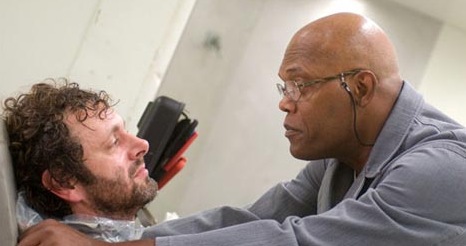
We need a synopsis here, but I’ll keep it quick and spoiler-free. Watch the trailer above for more of the the major bulletpoints. An Iowa-born American, ex-military, sends out a video claiming he’s placed nuclear bombs in three major cities set to go off in three days. All the agencies spring into action and converge on a high school gym where Younger a.k.a. “Yousef” is being held and interrogated. Samuel L. Jackson, Carrie Ann Moss and Michael Sheen earn their paychecks. A mysterious professional fingernail-puller, played convincingly by Mr. Jackson, is added to the mix and everyone begins to butt heads. Here’s an example of an exchange which I’m blatantly inventing – but it’s still pretty accurate:
“Don’t torture him! It’s bad. Take the bag off his head, Mr. Abu Ghraib. We’re human beings and Americans. We’re above this barbaric, medieval practice. What’s next – black plague and a jousting tournament?”
“Actually, there’s going to be about 10 million less Americans able to stand around, patting themselves on the back like you’re doing right now if we don’t get this traitorous, bearded whackadoo to tell us where the 3 bombs are in the next 72 hours. So there’s that, Garafalo.”
And… scene. That dynamic is the crux of what I love about this movie. The peacenik FBI agent is horrified that any kind of interrogation is happening, let alone the creative style that Jackson’s “H” brings to the gymnasium. But we also see H as a family man, loving father and generally likeable guy who honestly believes he is doing his duty for God and country. So who is right and who is wrong? To what ends is it reasonable to travel to save lives before we lower ourselves to the level of a terrorist. And is it appropriate for one gym full of people to get to decide for 10 million oblivious citizens who are also one step away from becoming radioactive dust?
The great vengeance and furious anger of Uncle Sam
I mentioned the quality of the writing before and Peter Woodward (son of Edward “The Equalizer”) has crafted a story which bucks the political drivel we’re used to being spoonfed by Hollywood and will cause you to have to think hard about how much is too much. Alternately, if you enjoy being spoonfed might I suggest Matt Damon in Green Zone which deserves to have a sin bin all to itself – which is then steam rolled like a pile of post-Pope picture tearing Sinead O’Connor DVDs. And then doused in kerosene. And then set ablaze. With Matt Damon strapped down, also inside of the bin. So yeah, really fucking hated Green Zone.
I implore you to seek the Unthinkable out and watch it. Watch it all the way through until the last second before the credits roll. You may find your usual moral high ground highly unstable in those final moments. It’s a smart, engaging and challenging film which deserves a wider audience. And thus ends my popcorn Jihad.


 i
i i
i i
i


 Infolinks is an in text


 out and watch it. Watch it all the way through until the last second before the credits roll. You may find your usual moral high ground highly unstable in those final moments. It’s a smart, engaging and challenging film which deserves a wider audience. And thus ends my popcorn Jihad.

